The Chemistry Behind Crop Protection: Understanding Surfactant Classes
Surfactants are the backbone of effective pesticide formulations, but not all are created equal. Selecting the right type—whether for emulsification, dispersion, or stabilization—is critical to unlocking formulation excellence.
Our latest guide breaks down the four main surfactant classes used in crop protection:
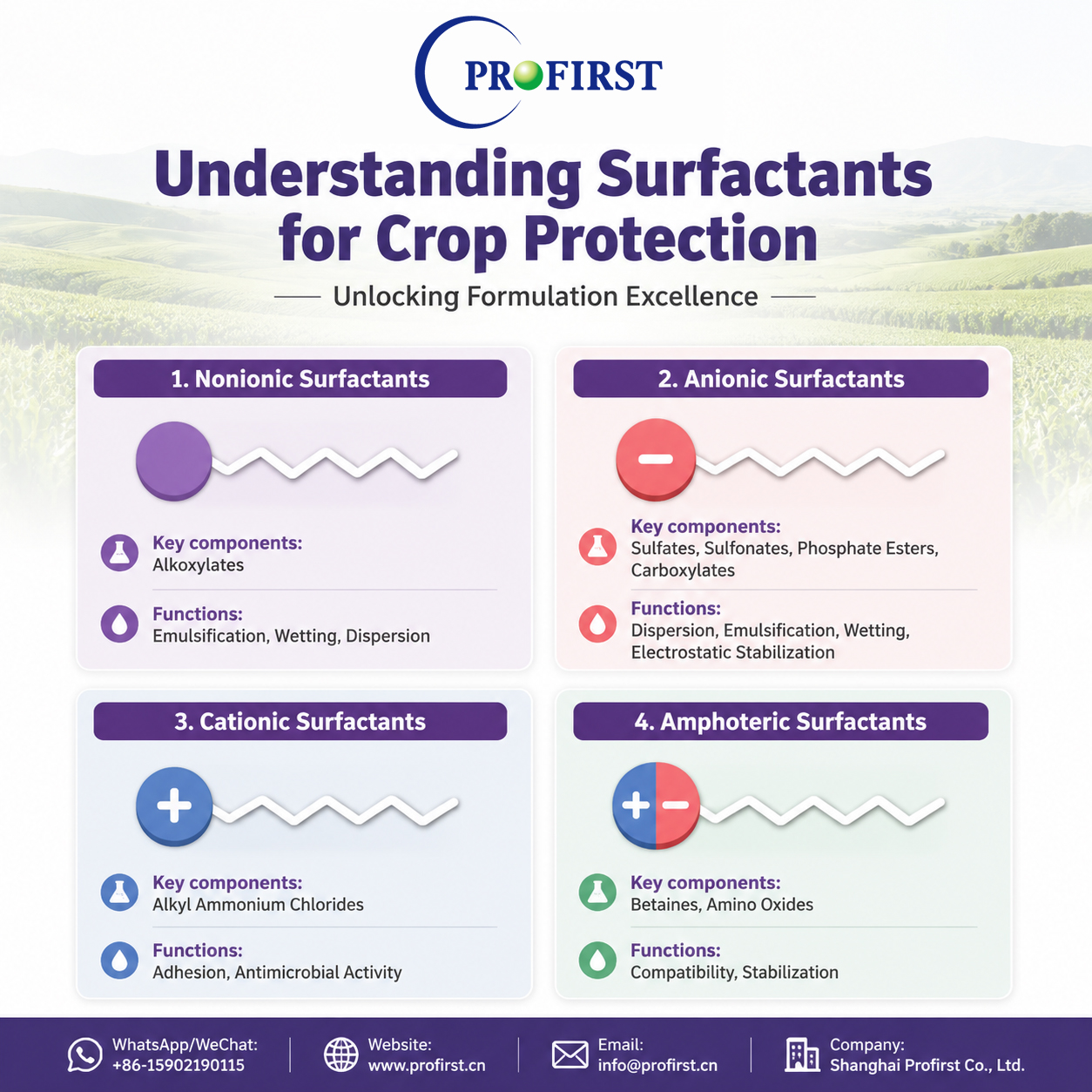
Nonionic Surfactants
Key Components: Alkoxylates
Functions: Emulsification, Wetting, Dispersion
These are the workhorses of the industry, prized for their versatility and compatibility across various formulations and water qualities .
Anionic Surfactants
Key Components: Sulfates, Sulfonates, Phosphate Esters, Carboxylates
Functions: Dispersion, Emulsification, Wetting, Electrostatic Stabilization
With a negative charge, they provide excellent dispersion and stabilization, often used in combination with nonionic surfactants.
Cationic Surfactants
Key Components: Alkyl Ammonium Chlorides
Functions: Adhesion, Antimicrobial Activity
Positively charged, these surfactants can enhance adhesion to negatively charged surfaces and provide biocidal properties. However, they must be used with care due to potential phytotoxicity risks .
Amphoteric Surfactants
Key Components: Betaines, Amino Oxides
Functions: Compatibility, Stabilization
Containing both positive and negative charges, these surfactants are highly compatible and stable across a broad pH range, making them valuable for complex formulations .
From nonionic workhorses to specialized anionic surfactants, choosing the right surfactant is the first step toward formulation excellence.
Explore Our Full Range of In-Can Additives: IN-CAN ADDITIVES-Adjuvants & Pesticides- Shanghai Profirst Co., Ltd.
Contact Susan Hu for formulation support & samples:
WhatsApp/WeChat: +86-15902190115
Email: [email protected] , [email protected]